
By Dr. Jignesh M. Gala — Vitreoretinal & Cataract Surgeon, Crystal Clear Eye Clinic, Andheri West, Mumbai
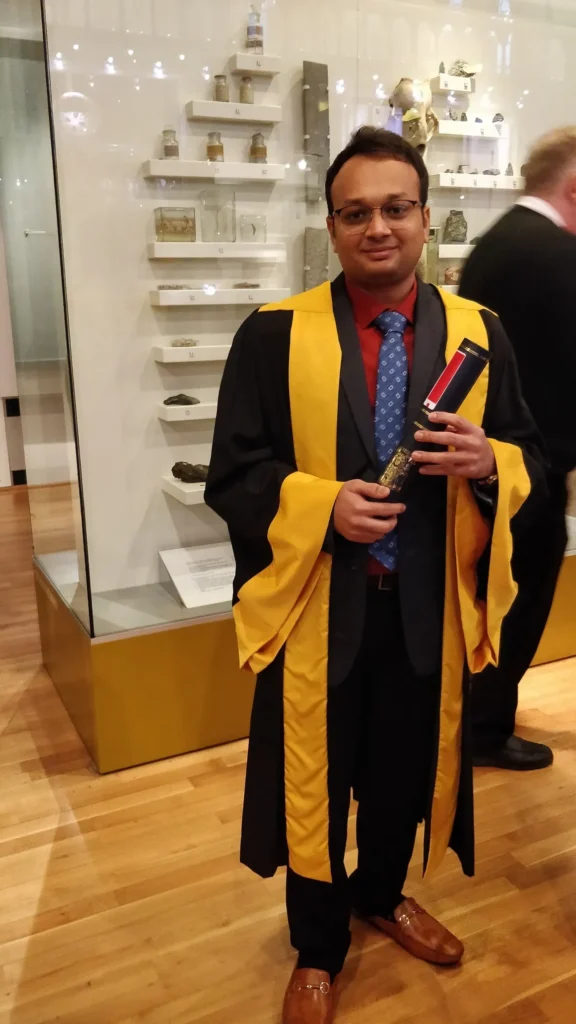
The Royal College of Surgeons of Edinburgh was founded in 1505. To put a number on that: when the College was incorporated by royal charter, Christopher Columbus had been dead for less than a year, the printing press was a recent invention, and the European Renaissance had not yet reached its full flowering.
I am, today, a Member of that College — by examinations completed in 2018, alongside my FRCS (Glasgow) — and the letters MRCS (Edinburgh) that I use after my name represent something I worked hard to earn.
In my previous post in this series, I wrote about my FRCS (Glasgow) and what that specialist fellowship represents. This post is about the other half of my Royal College story: the MRCS Edinburgh, which tested not just my ophthalmology but my surgical foundation in the broader sense, and admitted me into membership of a College that has, for over 520 years, set standards for surgical practice.
A 520-Year-Old Surgical College
The Royal College of Surgeons of Edinburgh (RCSEd) is one of the oldest and largest surgical institutions in the world. Based at its historic Nicolson Street campus in Edinburgh’s Old Town, it now has a membership network of over 33,000 professionals practising in more than 140 countries.
What makes RCSEd particularly distinctive is its breadth. While many peer institutions focus on a narrower band of surgical specialties, Edinburgh has welcomed surgeons across the full spectrum — general surgery, ophthalmology, ENT, orthopaedics, plastic surgery, urology, and more — under a single fellowship roof. The College’s approach to examination, examiner training, and continuing professional development is part of what has, for centuries, kept the standard of British surgical practice among the most respected in the world.
To be admitted to such an institution by examination is, by any honest measure, a meaningful credential.
The Intercollegiate MRCS — One Exam, Four Royal Colleges
Here is something many people, even within medicine, do not fully realise. Since January 2004, the MRCS examination has been intercollegiate, meaning that it is delivered as a single common exam shared by all four surgical Royal Colleges of the United Kingdom and Ireland:
- The Royal College of Surgeons of Edinburgh
- The Royal College of Physicians and Surgeons of Glasgow
- The Royal College of Surgeons of England
- The Royal College of Surgeons in Ireland
A candidate sits the same exam regardless of which College they choose to take their Membership through. The “Edinburgh” in MRCS (Edinburgh) indicates that I sat the Intercollegiate MRCS and elected to take my Membership through the Royal College of Surgeons of Edinburgh. The exam itself — the questions, the stations, the marking standards — is identical across all four colleges. This makes the MRCS one of the most rigorously standardised surgical postgraduate examinations in the world.
Part A — Five Hours, Two Papers
The MRCS examination is delivered in two parts. Part A is a five-hour written examination delivered in two separate papers on the same day:
- Paper 1 — Applied Basic Sciences (3 hours): Surgical anatomy, physiology, pathology, microbiology, biochemistry, and the principles that underpin how the human body responds to a surgical insult.
- Paper 2 — Principles of Surgery in General (2 hours): Pre-operative assessment, peri-operative care, post-operative complications, trauma management, oncological principles, and emergency surgical decision-making.
Together, the two papers comprise approximately 300 Single Best Answer multiple-choice questions and are designed, in the College’s own words, to test the “knowledge expected of a surgical trainee two to three years after qualification.”
The historical pass rate hovers around 30 percent. This is not a forgiving examination.
Part B — The OSCE
Part B is the Objective Structured Clinical Examination — a four-hour practical assessment delivered through a series of timed clinical stations. Candidates rotate through these stations, each focused on a specific competency, with examiners assessing performance in real time.
The OSCE tests:
- Anatomy and surgical pathology — identifying anatomical structures on cadaveric or imaging material and demonstrating understanding of disease processes.
- Applied surgical science and critical care — applying physiology and pathology to surgical scenarios under time pressure.
- Clinical, procedural and communication skills — examining patients, demonstrating procedural steps, and communicating clearly with patients, families, and colleagues.
The pass rate for Part B is approximately 50 percent, and candidates must complete both parts within seven years of passing Part A.
Part B is the section of the exam where theoretical knowledge meets the controlled chaos of clinical reality. It is one thing to know the anatomy of the inguinal canal in a textbook; it is quite another to demonstrate it under the watchful eyes of two senior surgeons with a stopwatch counting down.
Why an Ophthalmologist Sits the General Surgical MRCS
A reasonable question to ask is: Why does an ophthalmologist need a general surgical membership?
The honest answer is that the MRCS Edinburgh tests something that pure subspecialty training cannot. Ophthalmic surgery is a deeply specialised discipline — the operating field measures in millimetres, the instruments are precision-engineered, the tolerances are unforgiving. But it is still surgery, and the patient on the table has a heart, a brain, a clotting system, a metabolic state, and a psychological response to anaesthesia and procedure. All of these belong to the broader surgical body of knowledge that the MRCS exists to certify.
When I sat the MRCS Edinburgh, the preparation forced me back into general surgical territory I had not been formally tested on since my undergraduate years. I had to think again about wound healing, sepsis management, trauma resuscitation, and surgical decision-making in acutely unwell patients. None of it was wasted. Every one of those topics is relevant when a complex retinal case turns out to also be a complex systemic case — a diabetic with multiple comorbidities, a frail elderly patient on a careful balance of medications, or a young trauma victim whose eye injury is part of a broader injury pattern.
The MRCS made me a more complete surgical thinker. Not simply a more skilled ophthalmic technician, but a clinician who places the eye in the context of the whole patient.
The Combination That Matters
When you look at the letters after my name — MBBS, DOMS, FICO, MRCS (Edinburgh), FRCS (Glasgow), and the L V Prasad fellowships — the two Royal College qualifications work in a specific complementary way.
The MRCS (Edinburgh) certifies surgical foundation. Anatomy, physiology, principles, communication, the broad knowledge base of a competent general surgeon.
The FRCS (Glasgow) in Ophthalmology certifies specialist competence. The deep, applied knowledge required to manage ophthalmic disease independently as a consultant-grade specialist.
Holding both is, in many ways, the more important fact. Either qualification on its own represents a genuine achievement. The two of them together represent the foundation and the specialty — the breadth and the depth — that the British training tradition has, for centuries, considered the standard for safe independent surgical practice.
That is the standard I work to in every consultation and every operating theatre at Crystal Clear Eye Clinic.
A Note for Aspiring Trainees
If you are an ophthalmology trainee in India considering the MRCS pathway, my honest advice is the same as for the FRCS: it is genuinely worth doing, but go in with clear eyes about what it demands.
The MRCS will take you out of your specialty comfort zone. It will require you to revise material you may not have looked at carefully since your undergraduate years. It will demand a different kind of preparation — broader and more horizontal — than a specialty fellowship requires. But it will also make you a more complete surgical clinician, and that benefit lasts your entire career.
If I am being completely honest, I value the MRCS Edinburgh almost as much as the FRCS Glasgow — perhaps even slightly more, because the MRCS forced me to think outside the eye, and that turned out to matter more in practice than I had expected.
About the Author
Dr. Jignesh M. Gala is a vitreoretinal and cataract surgeon based at Crystal Clear Eye Clinic, Andheri West, Mumbai. He holds MRCS (Edinburgh) from the Royal College of Surgeons of Edinburgh and FRCS (Glasgow) from the Royal College of Physicians & Surgeons of Glasgow, along with FICO (London) from the International Council of Ophthalmology. He completed dual fellowships in Comprehensive Ophthalmology and Medical & Surgical Retina at L V Prasad Eye Institute, Hyderabad, and served as a Resident Physician in the Department of Ophthalmology at Tan Tock Seng Hospital, Singapore (2021–2023). He is a peer reviewer for BMJ Case Reports.
To book a consultation: 🌐 crystalcleareye.in 📞 +91 70450 00503 💬 WhatsApp +91 77188 85245 📍 Crystal Clear Eye Clinic, Laram Centre, Andheri West, Mumbai