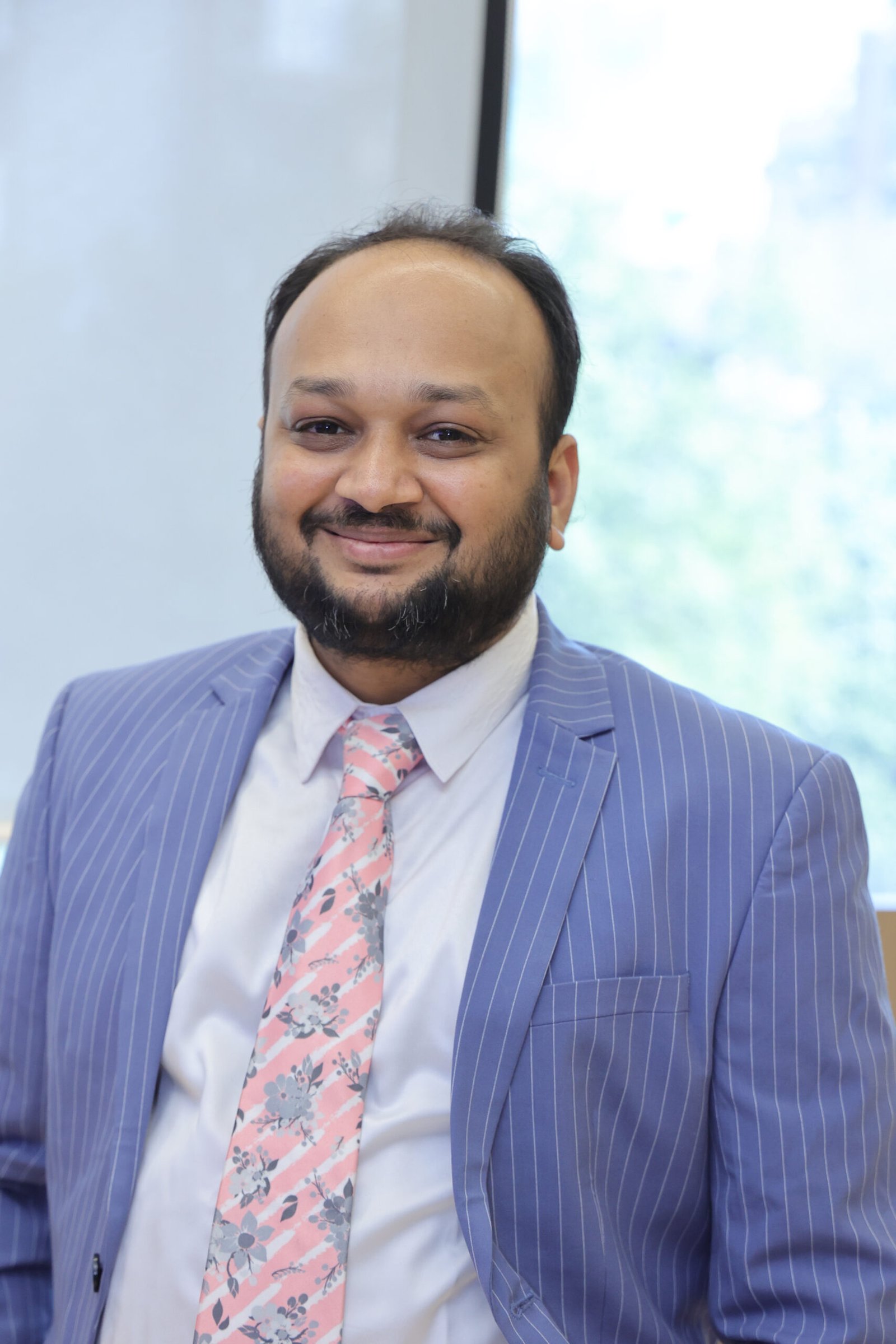
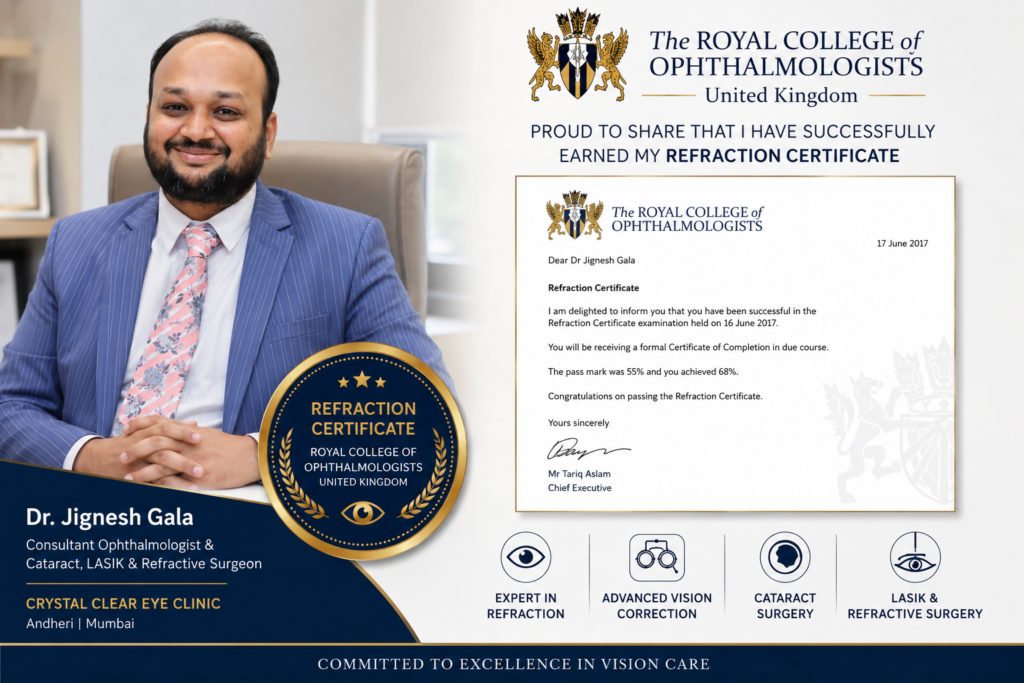
By Dr. Jignesh M. Gala — Vitreoretinal & Cataract Surgeon, Crystal Clear Eye Clinic, Andheri West, Mumbai
In June 2017, I travelled to Kuching, Malaysia, to sit one of the most practical and intensely hands-on examinations in clinical ophthalmology — the Refraction Certificate Examination of The Royal College of Ophthalmologists (RCOphth), London. There were no multiple-choice questions to revise for. There were no written papers to write. There was no oral viva on a textbook subject. For the duration of the examination, I moved from one clinical station to the next, with a different patient at each, an examiner watching every move, and a retinoscope or trial frame in my hand.
I passed on my first attempt. The official letter from the College, dated 14 July 2017, signed by Susannah Grant, Head of the Examinations Department, confirms the result. But the bigger point of this post is not the result. It is the examination itself — and what an exam structured this way is really testing.
The Royal College of Ophthalmologists
The Royal College of Ophthalmologists (RCOphth) is the professional body responsible for ophthalmology in the United Kingdom. Granted its Royal Charter in 1988, the College is based at 18 Stephenson Way, London NW1 2HD. It sets the curriculum, standards, and examinations for UK ophthalmic training, accredits training programmes, oversees continuing professional development, and represents British ophthalmology to government and the wider medical community.
The College conducts a structured series of examinations that ophthalmology trainees must pass to progress through their training. The Refraction Certificate Examination is one of these — the first compulsory practical assessment that every trainee must clear before progressing to the higher specialty examinations of the College.
Why a Refraction Examination Exists
If you are a patient reading this and wondering why a college of surgeons would devote an entire stand-alone examination to refraction — which most people associate with the simple “1 or 2? Better with 1 or with 2?” of an optometry visit — the answer is straightforward.
Refraction is the most fundamental skill in clinical ophthalmology. Before any patient can be properly assessed for cataract surgery, before any decision can be made about LASIK, before any retinal scan can be properly interpreted, before any premium intraocular lens can be selected, the patient’s refractive state must be measured accurately. A surgeon who cannot perform a precise refraction on a real patient — at the slit lamp, with a trial frame, in a busy clinic — cannot deliver consistent surgical outcomes. The College’s view is that refraction must be demonstrated, not merely studied. The Refraction Certificate exists to enforce that.
A Multi-Station OSCE on Real Patients
The Refraction Certificate is delivered as a structured Objective Structured Clinical Examination (OSCE) — a series of discrete stations, each worth a defined number of marks, with a separate examiner observing at each station. The candidate rotates between stations. There are no simulated patients. The patients are real, present in person, and consenting to be examined by an unfamiliar candidate under examination conditions.
The stations I sat at, in Kuching that morning, included:
- Cycloplegic retinoscopy — performed on a patient whose accommodation had been pharmacologically relaxed using cycloplegic eye drops, allowing an objective measurement of the refractive error free from accommodative interference. Both right and left eyes were assessed.
- Non-cycloplegic retinoscopy — the same skill, but without dilation, requiring the candidate to obtain an accurate reading despite the patient’s natural accommodation.
- Subjective refraction: sphere refinement — refining the spherical component of the prescription using a trial frame, starting from a given mid-point.
- Subjective refraction: cylinder refinement — using Jackson cross-cylinder technique to refine the cylindrical power and axis.
- Subjective refraction: binocular balance — using duochrome, plus-one blur back, or the Modified Humphriss Immediate Contrast Test to ensure both eyes are equally accommodating at the chosen endpoint.
- Lens neutralisation, with or without a focimeter — measuring an existing pair of spectacles to determine their prescription, including sphere, cylinder, axis, near addition, and prism if present.
- Visual acuity, trial frame fitting, interpupillary distance, and back vertex distance — the foundational clinical measurements that determine whether a final prescription will translate accurately into a comfortable, well-fitting pair of glasses.
- Near addition — taking a history from a presbyopic patient about their reading habits, occupation, and visual requirements, and prescribing an appropriate reading addition with explanation of lens type options (single vision, bifocal, varifocal).
Each station was assessed for two distinct things: the accuracy of the refractive outcome — marked later by computer against a known correct answer — and the technique used to arrive at it — marked in real time by the examiner watching from a few feet away.
Real Patients, From Diverse Backgrounds
One of the things that makes the Kuching examination centre particularly representative of real-world practice is its patient pool. During the morning I sat, I examined patients across the Malaysian demographic — Chinese, Indian, and Malay ethnic backgrounds — alongside European patients of differing ages. Adult patients. Presbyopic patients. Younger patients requiring cycloplegia to bypass their strong accommodative reflexes.
A refractionist who can work confidently across this range of patients — different ages, different refractive errors, different facial anatomies, different first languages — is much closer to the kind of practitioner the College wishes to certify. The diversity of patients in the examination is, in itself, part of the test.
Why This Exam Was Different From All the Others
I have written elsewhere on this blog about my FICO from the International Council of Ophthalmology, my MRCS Edinburgh and FRCS Glasgow, and my Medical & Surgical Retina fellowship at L V Prasad Eye Institute. Each of those examinations tested something important, and each demanded its own form of preparation.
The Refraction Certificate was different from every one of them in a single specific way: it was entirely practical. There was no written paper. There was no MCQ section. There was no opportunity to recover from a difficult station by writing a brilliant essay later, or by carrying a strong written paper forward into a viva. Every mark I scored, I scored in front of a real person — a patient with a real refractive error, examined by me, with an examiner watching from a few feet away.
A pure-OSCE examination of this kind rewards only one thing: practical competence. You cannot bluff your way through subjective refraction. You cannot reason your way out of an inaccurate retinoscopy reading. The discipline of preparing for the exam — and the discipline of sitting it — is, in my view, one of the most efficient ways a clinician can be forced to confront the gap between what they think they can do and what they can actually demonstrate, under observation, on someone they have just met.
I came back from Kuching a more careful refractionist than I had been before. Eight years on, I still feel the influence of that preparation in every refraction I perform.
What This Means for the Patients I See in Mumbai
When a patient sits in front of me at Crystal Clear Eye Clinic in Andheri West today — whether for a routine spectacle prescription, a pre-cataract refraction, a LASIK assessment, or a premium intraocular lens calculation — the foundation of what I do is exactly the foundation the Refraction Certificate tested. Get the refraction right, and everything downstream — surgical planning, IOL choice, post-operative satisfaction — is much more likely to fall into place.
Patients rarely realise how much of their eventual surgical outcome depends on the precision of measurements taken before the surgery even begins. A 0.25 dioptre error in the pre-operative refraction can be the difference between a patient who is delighted with their new lens and a patient who is wearing glasses they had hoped to be free of.
The Refraction Certificate of The Royal College of Ophthalmologists is the examination that, in 2017, formally certified that I could be trusted to take those measurements correctly. The College gave me a piece of paper that summer. The skills behind that piece of paper, I bring to work every day.
About the Author
Dr. Jignesh M. Gala is a vitreoretinal and cataract surgeon based at Crystal Clear Eye Clinic, Andheri West, Mumbai. He holds the Refraction Certificate of The Royal College of Ophthalmologists, London (2017), FICO (London) from the International Council of Ophthalmology (2016), MRCS (Edinburgh) and FRCS (Glasgow) — dual Royal College surgical qualifications from the United Kingdom (both 2018). He completed dual fellowships in Comprehensive Ophthalmology and Medical & Surgical Retina at L V Prasad Eye Institute, Hyderabad, and served as a Resident Physician with the Department of Ophthalmology, Woodlands Health (NHGEI), Singapore (2021). He has been a peer reviewer for BMJ Case Reports since November 2019.
To book a consultation: 🌐 crystalcleareye.in 📞 +91 70450 00503 💬 WhatsApp +91 77188 85245 📍 Crystal Clear Eye Clinic, Laram Centre, Andheri West, Mumbai